
If you have ever wondered what actually happens during a Balinese massage and why your body will thank you afterwards, you are not alone. Most travellers arrive in Bali with the vague intention of "getting a massage at some point" without really knowing what they are walking into. The good news is that understanding what actually happens during a Balinese massage and why your body will thank you afterwards is the first step toward having one of the most genuinely restorative experiences of your entire trip. At littlehutspa.com, a small family spa tucked in a quiet village on the northwest edge of Ubud, this tradition is practised the way it has always been — with real skill, natural ingredients, and none of the performance that larger resort spas tend to layer on top.
What Makes a Balinese Massage Different From Everything Else
Before getting into exactly what actually happens during a Balinese massage and why your body will thank you afterwards, it helps to understand what sets this particular tradition apart. A Balinese massage is not a single technique. It is a carefully sequenced combination of several distinct approaches, applied across the full body in a specific order that has been developed and refined over centuries of Balinese healing practice.
Where a Swedish massage focuses primarily on muscle relaxation through long gliding strokes, and a Thai massage works heavily on stretching and joint mobilisation, a Balinese massage does something more layered. It moves through the body addressing circulation, tension, energy flow, and skin health — often within a single session. This is why understanding what actually happens during a Balinese massage and why your body will thank you afterwards matters so much: it is genuinely doing more than one thing at once.
What Happens in the First Few Minutes
The session typically begins before your therapist has touched you at all. You will be welcomed with a drink — often a warm herbal blend of ginger, lemongrass, or local medicinal plants — and given a moment to settle. This is intentional. The body does not release tension the instant you lie down on a table. The opening ritual of a Balinese massage is designed to signal to your nervous system that it is safe to stop bracing.
Your therapist will begin at the back, using their palms to apply gentle, steady pressure along either side of the spine. This is not a diagnostic scan or a warm-up exercise. It is an active part of what actually happens during a Balinese massage and why your body will thank you afterwards — because stimulating circulation along the back muscles from the start means the deeper work that follows is received by tissue that is already beginning to open rather than tissue that is still guarded.
The Core Techniques Used During the Treatment
- Effleurage strokes: Long, flowing movements applied with the full hand or forearm across large muscle groups. These strokes warm the tissue, encourage lymphatic drainage, and create the initial wave of relaxation that most people associate with the opening minutes of any good massage.
- Petrissage and skin rolling: The therapist lifts, rolls, and kneads sections of skin and the tissue beneath it. This is where what actually happens during a Balinese massage and why your body will thank you afterwards starts to become physically demonstrable — skin rolling breaks down fascial adhesions, the tight bands of connective tissue that accumulate from prolonged sitting, poor posture, and unresolved physical stress.
- Deep thumb and knuckle pressure: Applied to specific points along the muscle belly and at trigger points — areas of concentrated tension that refer pain to other parts of the body. This is the technique most likely to produce that particular sensation of pressure that sits right on the edge of discomfort and relief.
- Palm and heel pressure: Used across the back, glutes, and thighs to compress and release large muscle groups. Effective on areas where the tissue is dense and where lighter techniques cannot reach the root of the tension.
- Acupressure point work: Applied to specific points along the body's energy pathways as understood in traditional Balinese healing. Whether or not you subscribe to the energetic framework, the physical effect of sustained pressure at these points is well documented — local blood flow increases, muscle tone normalises, and the local nervous system response shifts toward parasympathetic activation.
- Stretching and range of motion work: Gentle passive stretches applied to the limbs, particularly the legs and arms. This is less dramatic than Thai massage stretching but is an important part of what actually happens during a Balinese massage and why your body will thank you afterwards — it resets the resting length of muscles that have been held in shortened positions.
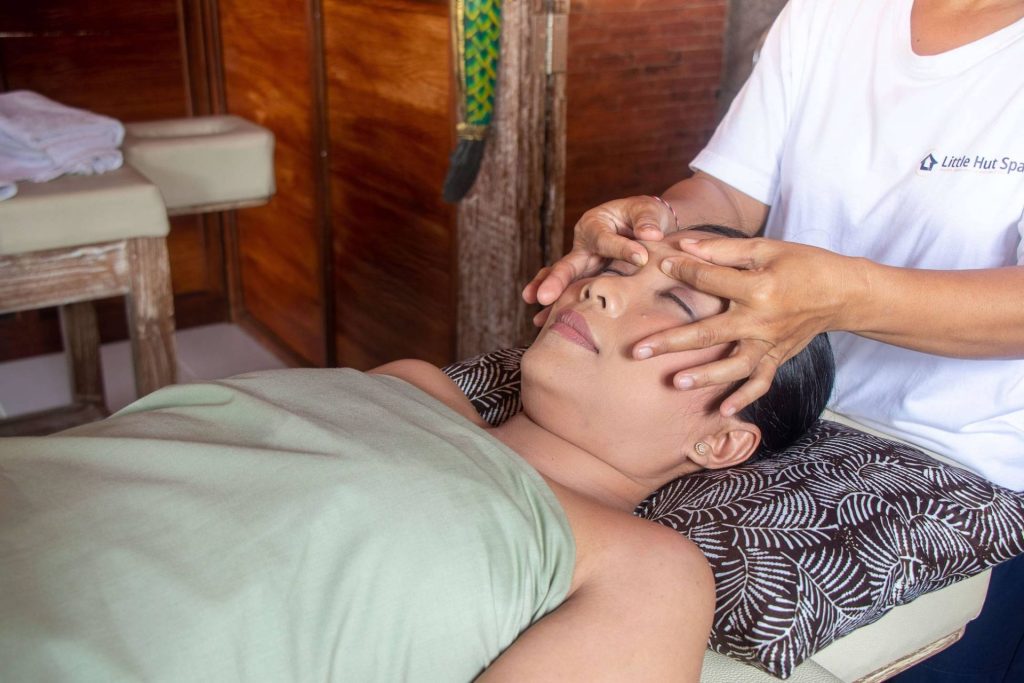
- Scalp and facial work: The session typically closes with attention to the head, scalp, and sometimes the face. Scalp massage increases blood circulation to the follicles, relieves the tension that accumulates in the suboccipital muscles at the base of the skull, and produces a quality of relaxation that the rest of the body cannot quite replicate.
What Is Being Applied to Your Skin
Traditional Balinese massage uses warm oil infused with local botanicals. Frangipani, ylang-ylang, coconut, and various medicinal plants are the most common. The oil serves a practical function in reducing friction during the strokes, but it also plays an active role in the skin-level benefits of the treatment. Many of the plant compounds used in traditional Balinese massage oils have genuine anti-inflammatory and circulatory properties that complement the mechanical work of the massage itself.
At a family spa that uses ingredients sourced from local tradition rather than from a commercial supplier, this element of the treatment tends to be more authentic. The oil smells the way Bali smells — like flowers and something older and earthier underneath.
What Your Body Is Actually Doing During the Session
This is where what actually happens during a Balinese massage and why your body will thank you afterwards becomes genuinely interesting from a physiological standpoint.
- Cortisol decreases: Within the first fifteen to twenty minutes of skilled touch, cortisol levels in the bloodstream begin to fall. Cortisol is the primary stress hormone, and elevated cortisol is associated with everything from disrupted sleep to impaired immune function. A drop in cortisol is not a placebo effect. It is a measurable biochemical shift.
- Serotonin and dopamine increase: The body responds to therapeutic touch by releasing neurotransmitters associated with mood regulation, reward, and calm. This is part of the reason why the effects of a good Balinese massage can persist well beyond the treatment itself.
- Circulation improves locally and systemically: The combination of strokes, pressure, and stretching increases blood flow to the treated areas. Oxygenated blood reaches tissue that may have been relatively starved of it, and metabolic waste products are moved more efficiently toward the lymphatic system for clearance.
- Muscle tension releases at a neurological level: The sustained pressure applied during a Balinese massage activates the Golgi tendon organs — sensory receptors embedded in the muscle-tendon junction that, when stimulated, send an inhibitory signal to the muscle, causing it to release. This is why the deep pressure in a Balinese massage does not hurt in a damaging way. It triggers the body's own release mechanism.
- The parasympathetic nervous system activates: Heart rate slows. Breathing deepens. Digestion resumes normal function. The body moves out of the fight-or-flight state that most people spend the majority of their waking hours in, and into the rest-and-repair state that allows actual healing to happen.
What You Will Feel in the Hours That Follow
This is the part that catches most first-timers by surprise. The effects of what actually happens during a Balinese massage and why your body will thank you afterwards are not confined to the hour you spend on the table. Most people report a quality of physical ease in the hours following treatment that feels qualitatively different from ordinary tiredness or relaxation.
Muscles that have been chronically contracted for weeks or months feel genuinely different. The kind of low-level background tension that most people have simply accepted as normal — across the shoulders, at the base of the neck, in the hip flexors — lifts in a way that feels almost structural rather than superficial.
Sleep on the night following a Balinese massage is frequently reported as unusually deep. This is consistent with what we know about the relationship between parasympathetic activation and sleep quality. When the nervous system has genuinely downregulated during the day, it does not need to spend the first few hours of the night doing the same thing.
Why the Setting Changes Everything
What actually happens during a Balinese massage and why your body will thank you afterwards is shaped not just by technique and ingredients but by environment. A Balinese massage performed in an anonymous hotel corridor with thin walls and the ambient noise of a lobby does not deliver the same result as one performed in a small, open-sided treatment room surrounded by the sounds of a Balinese garden.
The sensory context matters because the nervous system is reading all of it. The smell of frangipani, the sound of birds, the warmth of tropical air moving through an open space — these inputs all contribute to the depth of the parasympathetic response, and by extension to the completeness of what actually happens during a Balinese massage and why your body will thank you afterwards.
This is one of the reasons that a small family spa near Ubud, where the surrounding village context is part of the experience rather than something screened out by soundproofing and air conditioning, often produces a more complete result than a treatment that costs five times as much inside a resort.
A Note on What to Expect Before You Go
Arriving well hydrated makes a material difference to how the treatment feels and how the tissue responds to the work. Eating a large meal immediately beforehand is not recommended. Arriving a few minutes early allows the transition out of travel mode and into receptive mode, which affects how quickly the body is able to respond to the treatment.
If there are specific areas of tension or discomfort, mentioning them at the start means your therapist can give them appropriate attention without having to guess. Pressure preference is worth communicating clearly — not because therapists cannot read physical feedback, but because preferences vary enough that an explicit conversation at the beginning removes any ambiguity.
After the session, the herbal drink that follows is not decorative. It is a practical support for the lymphatic and digestive activity that the treatment has set in motion. Drink it, sit quietly for a few minutes, and resist the impulse to immediately return to whatever was waiting on your phone.